Bajaj Finserv Credit Card Hub
Bajaj Finserv Credit Card Hub
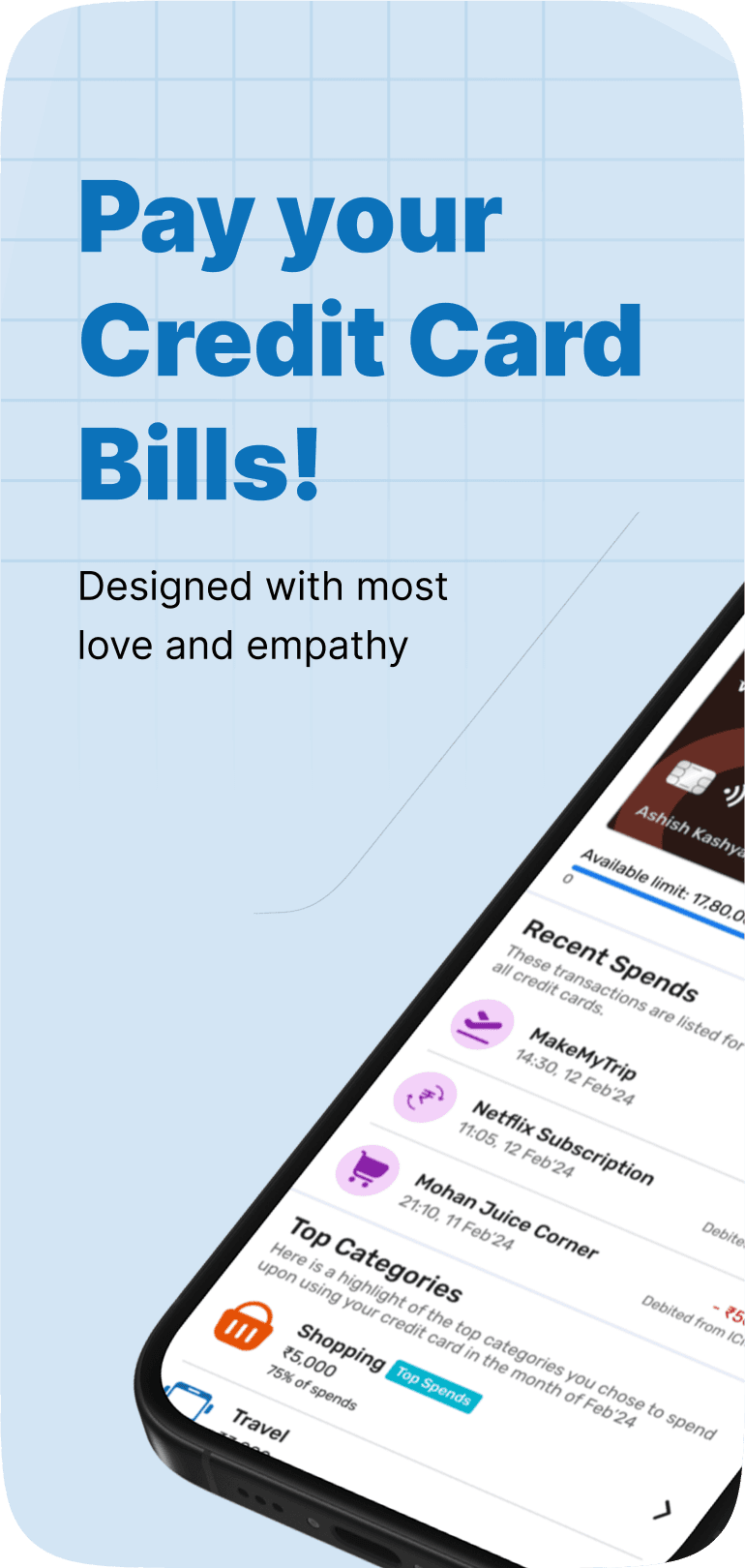
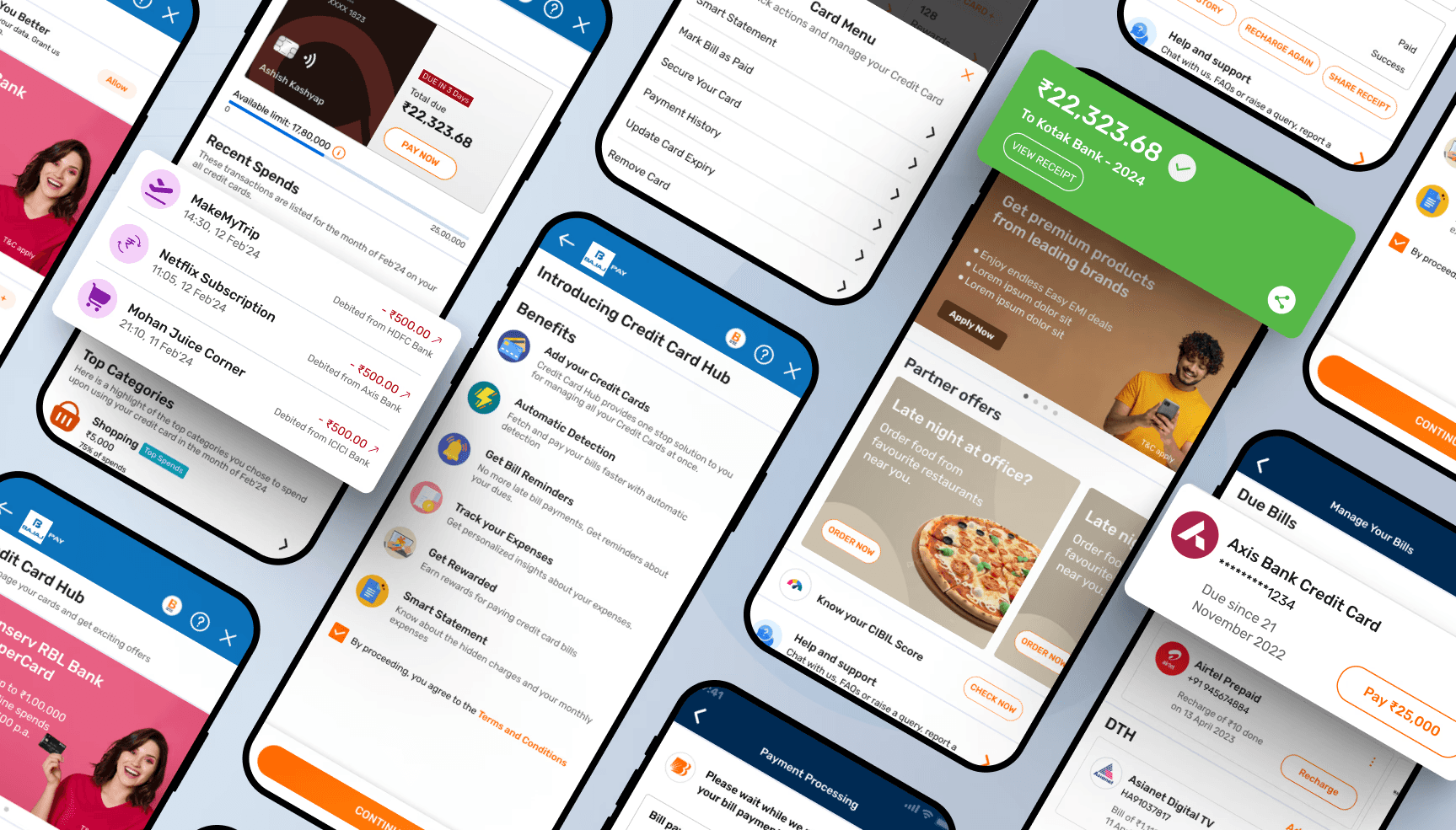
Managing credit cards efficiently is crucial in today’s fast-paced financial world. Bajaj Finserv has introduced its Credit Card Hub, aiming to provide a seamless, intuitive, and feature-rich experience for users. This new design improves accessibility, enhances personalization, and integrates key financial tools, making credit management easier than ever. Experience it yourself here!
Managing credit cards efficiently is crucial in today’s fast-paced financial world. Bajaj Finserv has introduced its Credit Card Hub, aiming to provide a seamless, intuitive, and feature-rich experience for users. This new design improves accessibility, enhances personalization, and integrates key financial tools, making credit management easier than ever. Experience it yourself here!
Finance
Finance
Credit Card
Credit Card
Payments
Payments
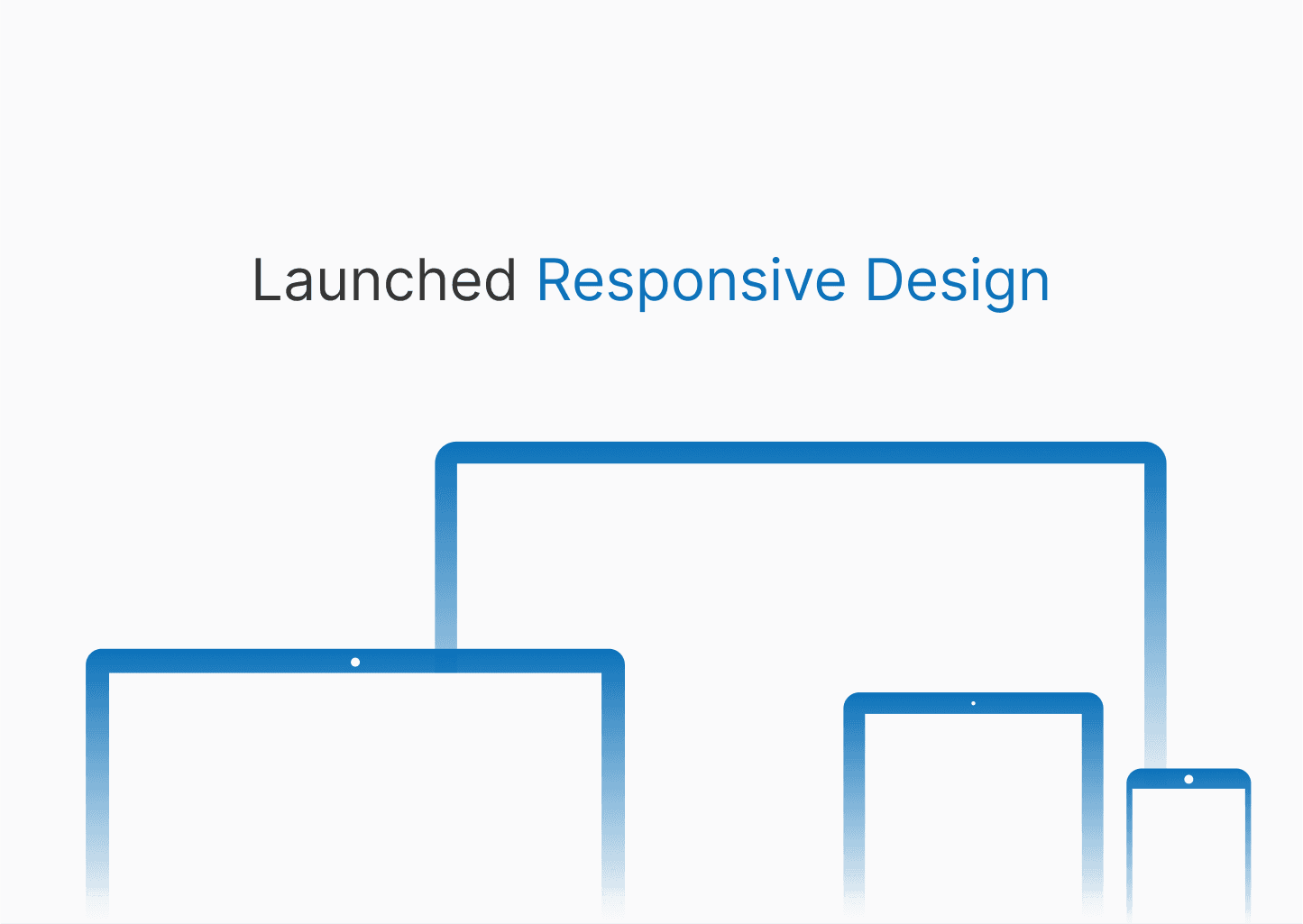
Responsive Design
Responsive Design
[ DELIVERABLES ]
[ DELIVERABLES ]
Responsive Design
Responsive Design
[ DURATION ]
[ DURATION ]
4 Months
4 Months
[ COMPANY ]
[ COMPANY ]
Bajaj Finserv
Bajaj Finserv
[ ROLE ]
[ ROLE ]
Product/UX Designer
Product/UX Designer
Bajaj Finserv’s credit card bill payment system thrived due to cashback incentives, despite a low retention rate. How can we replicate this success with Credit Card Hub as a solution while achieving higher retention and reducing reliance on cashback offers?
Bajaj Finserv’s credit card bill payment system thrived due to cashback incentives, despite a low retention rate. How can we replicate this success with Credit Card Hub as a solution while achieving higher retention and reducing reliance on cashback offers?

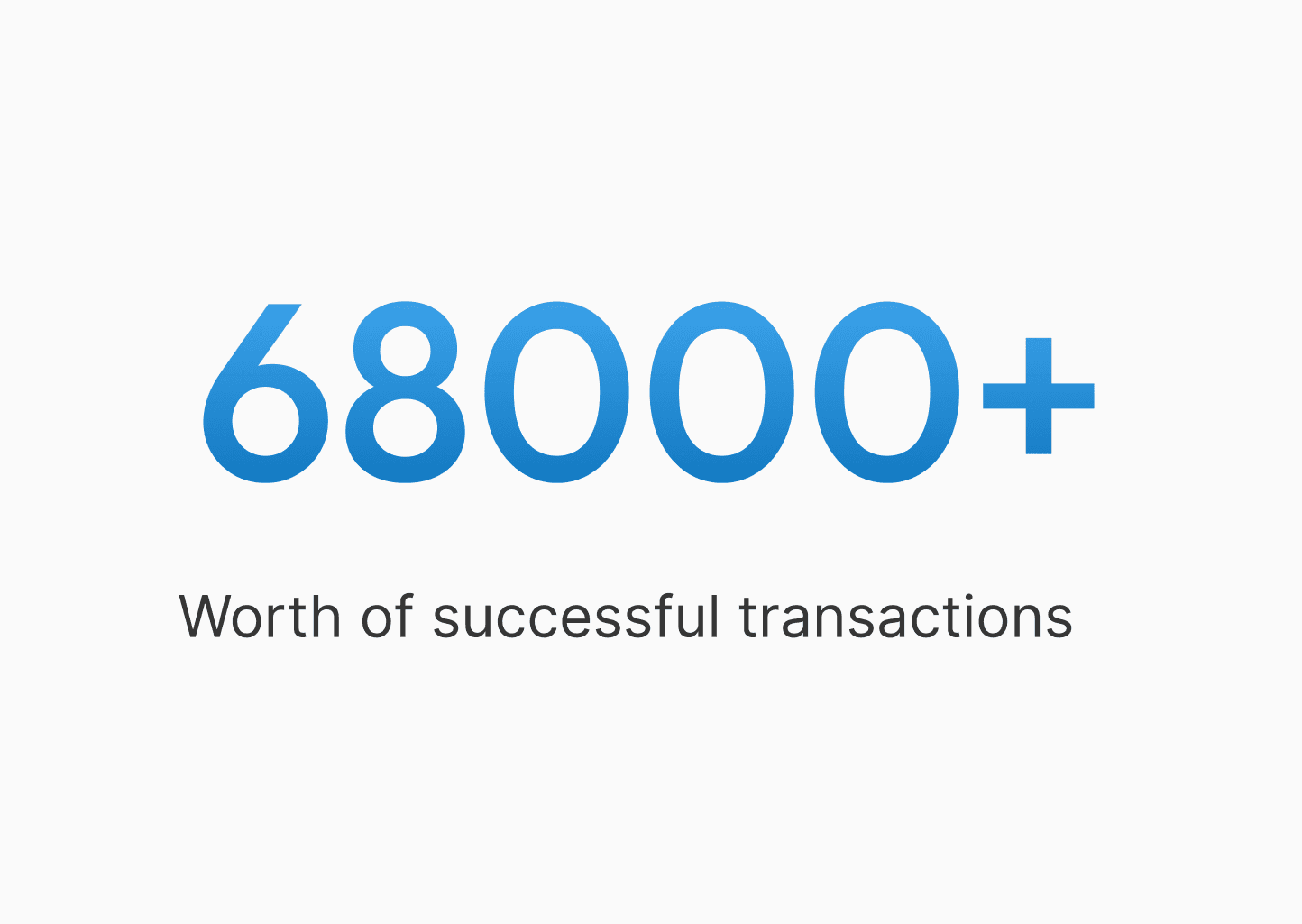


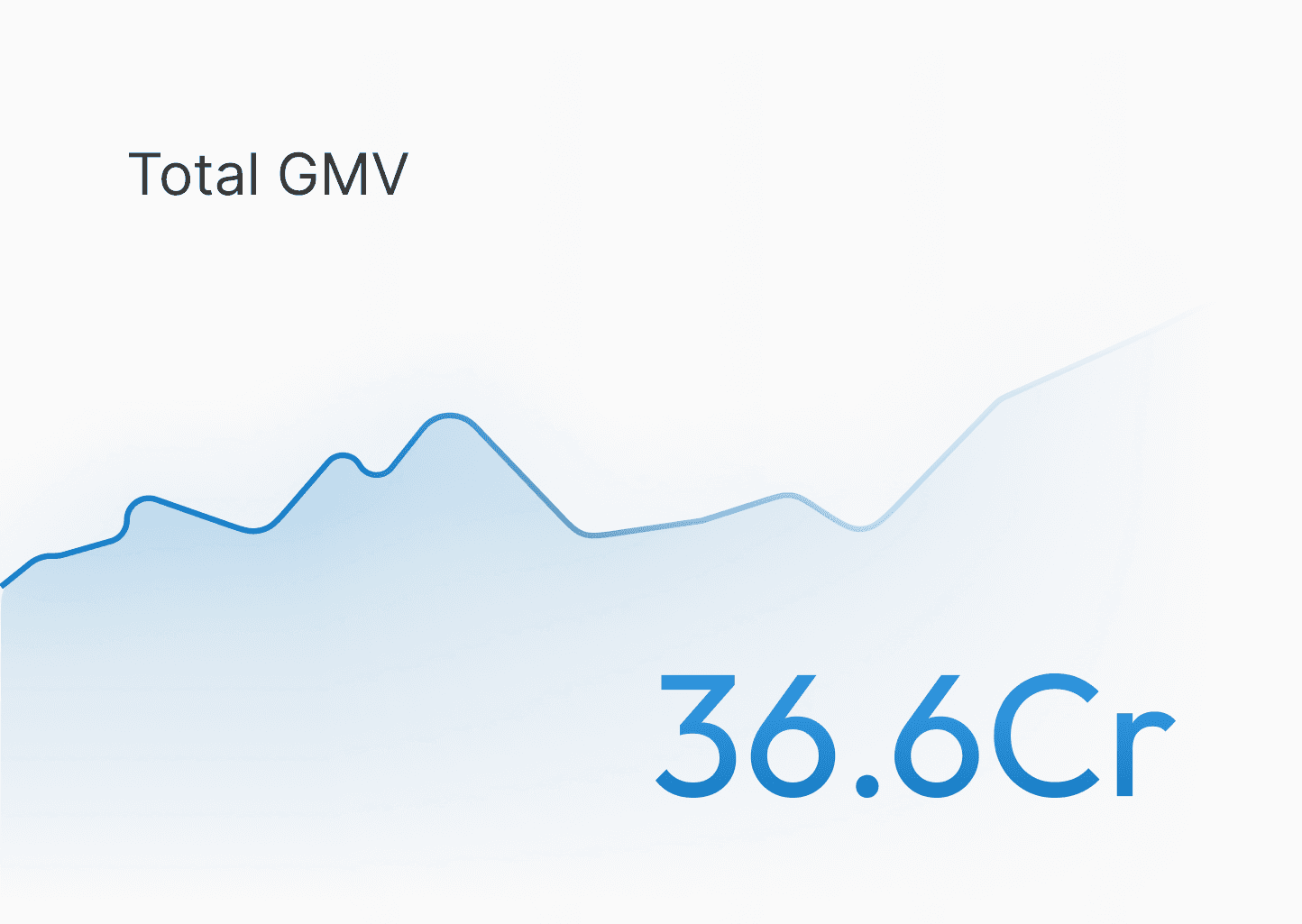
In India, where digital finance is rapidly evolving, Bajaj Finserv took on an ambitious challenge. With a growing user base exceeding 100 million, Bajaj Finserv sought a revolutionary transformation. The goal was to enhance digital ROI by creating a smart, intuitive, and feature-rich Credit Card Hub that meets the dynamic expectations of India’s tech-savvy consumers.
In India, where digital finance is rapidly evolving, Bajaj Finserv took on an ambitious challenge. With a growing user base exceeding 100 million, Bajaj Finserv sought a revolutionary transformation. The goal was to enhance digital ROI by creating a smart, intuitive, and feature-rich Credit Card Hub that meets the dynamic expectations of India’s tech-savvy consumers.
Buisness Goals & Stakeholder Insights
Buisness Goals & Stakeholder Insights
Need to showcase tokenised cards, Customers should feel they have a real card in their wallet
The new hub places credit card dues and payment options prominently on the app’s home screen
Users can view all cards, with individual card insights and an overall summary, including spending patterns and dues
Detailed analytics allow users to review their spending by categories and merchants
A one-time onboarding flow auto-updates card information, reducing repetitive entry and ensuring security through tokenisation
A one-time onboarding flow auto-updates card information, reducing repetitive entry and ensuring security through tokenisation
The design naturally integrates other financial products, driving engagement through personalised recommendations
The design naturally integrates other financial products, driving engagement through personalised recommendations
Expanded functionality to include non-BBPS cards, broadening the user base and utility
Users receive timely notifications about dues and updated CIBIL scores, promoting financial responsibility
Users receive timely notifications about dues and updated CIBIL scores, promoting financial responsibility
Customisable card nicknames and settings enhance the personal touch, leading to improved user satisfaction

Yeah, guess the intern budget was little tight
Yeah, guess the intern budget was little tight
Yeah, guess the intern budget was little tight
Yeah, guess the intern budget was little tight
My Contribution
My Contribution
I played an active role as an individual contributor throughout the project. My participation spanned the entire design process, including problem definition, conceptualization, idea generation, design, selected aspects of user testing, iterating wireframes, and refining the final design direction. This collaborative effort ensured a seamless and user-centric credit management experience, aligning with Bajaj Finserv’s vision for financial innovation.
I played an active role as an individual contributor throughout the project. My participation spanned the entire design process, including problem definition, conceptualization, idea generation, design, selected aspects of user testing, iterating wireframes, and refining the final design direction. This collaborative effort ensured a seamless and user-centric credit management experience, aligning with Bajaj Finserv’s vision for financial innovation.
Finance
Finance
Credit Card
Credit Card
Payments
Payments
Responsive Design
Responsive Design
Identifying Gaps and Opportunities
Identifying Gaps and Opportunities
We analyzed various stages of the customer journey, drawing insights from market leaders like CRED and PhonePe. Based on this, we formulated key assumptions to design CC Hub in a way that maximizes retention while minimizing reliance on cashback incentives.
We analyzed various stages of the customer journey, drawing insights from market leaders like CRED and PhonePe. Based on this, we formulated key assumptions to design CC Hub in a way that maximizes retention while minimizing reliance on cashback incentives.
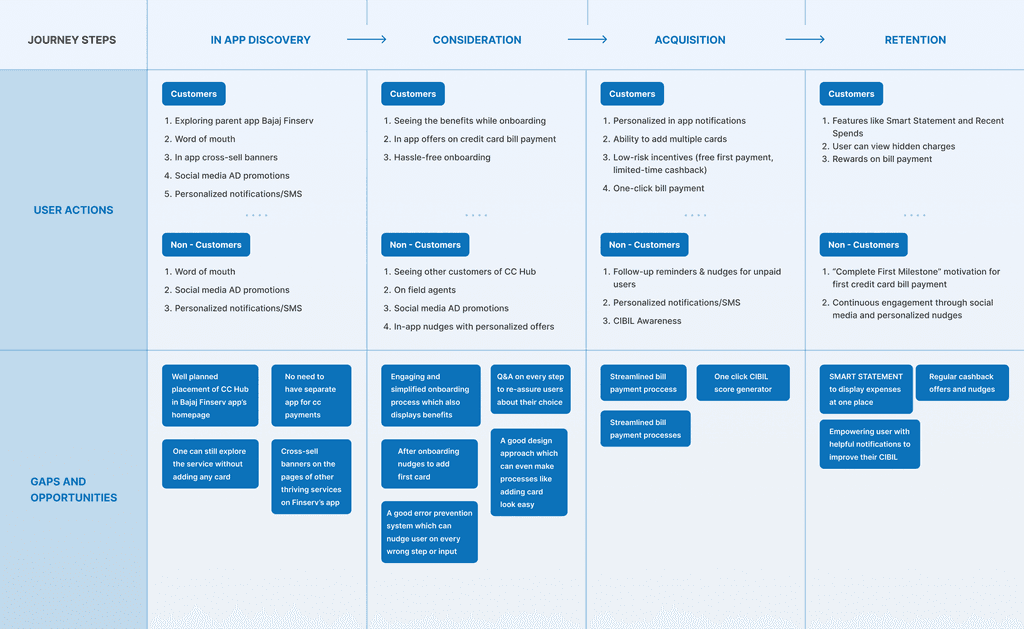
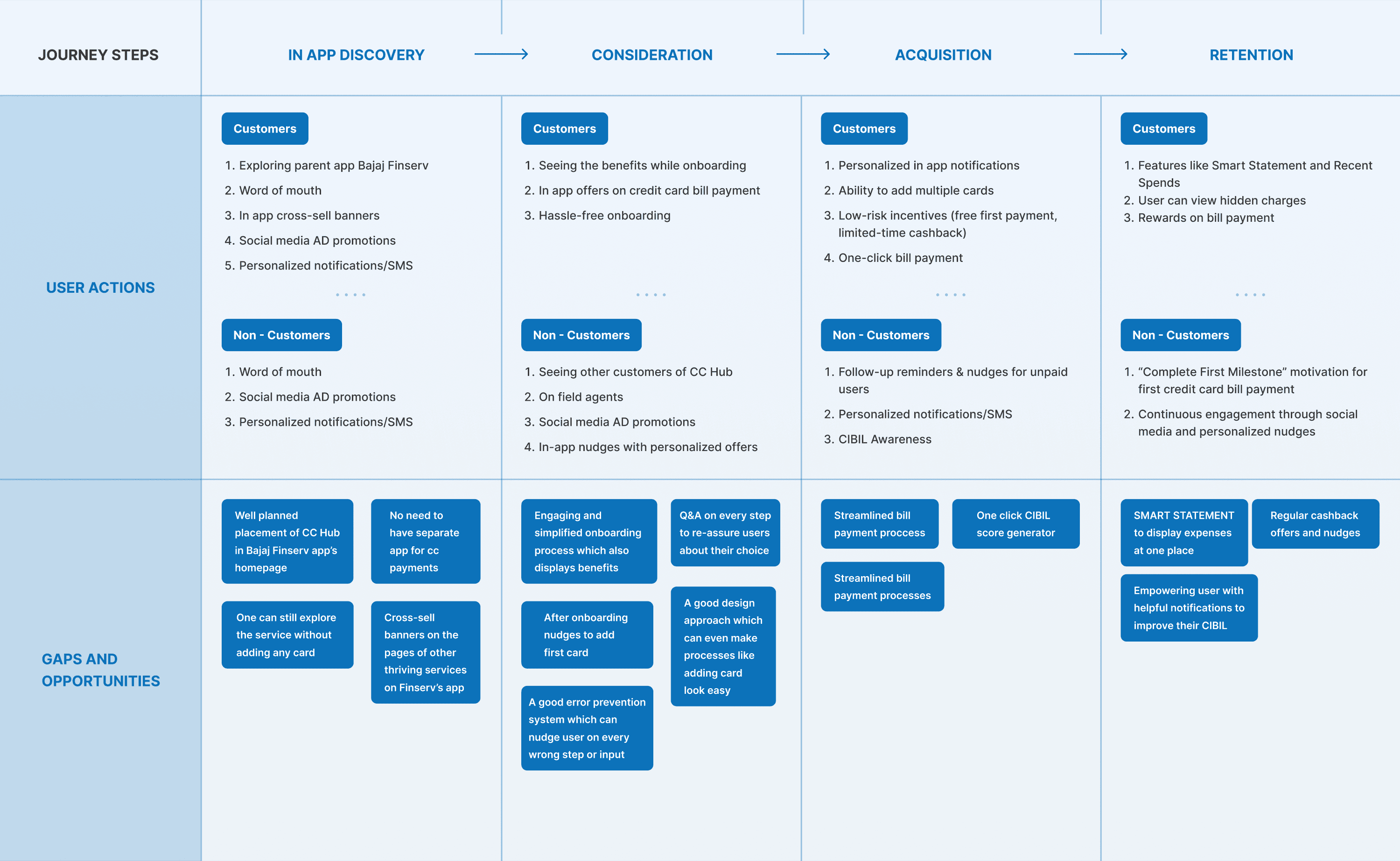
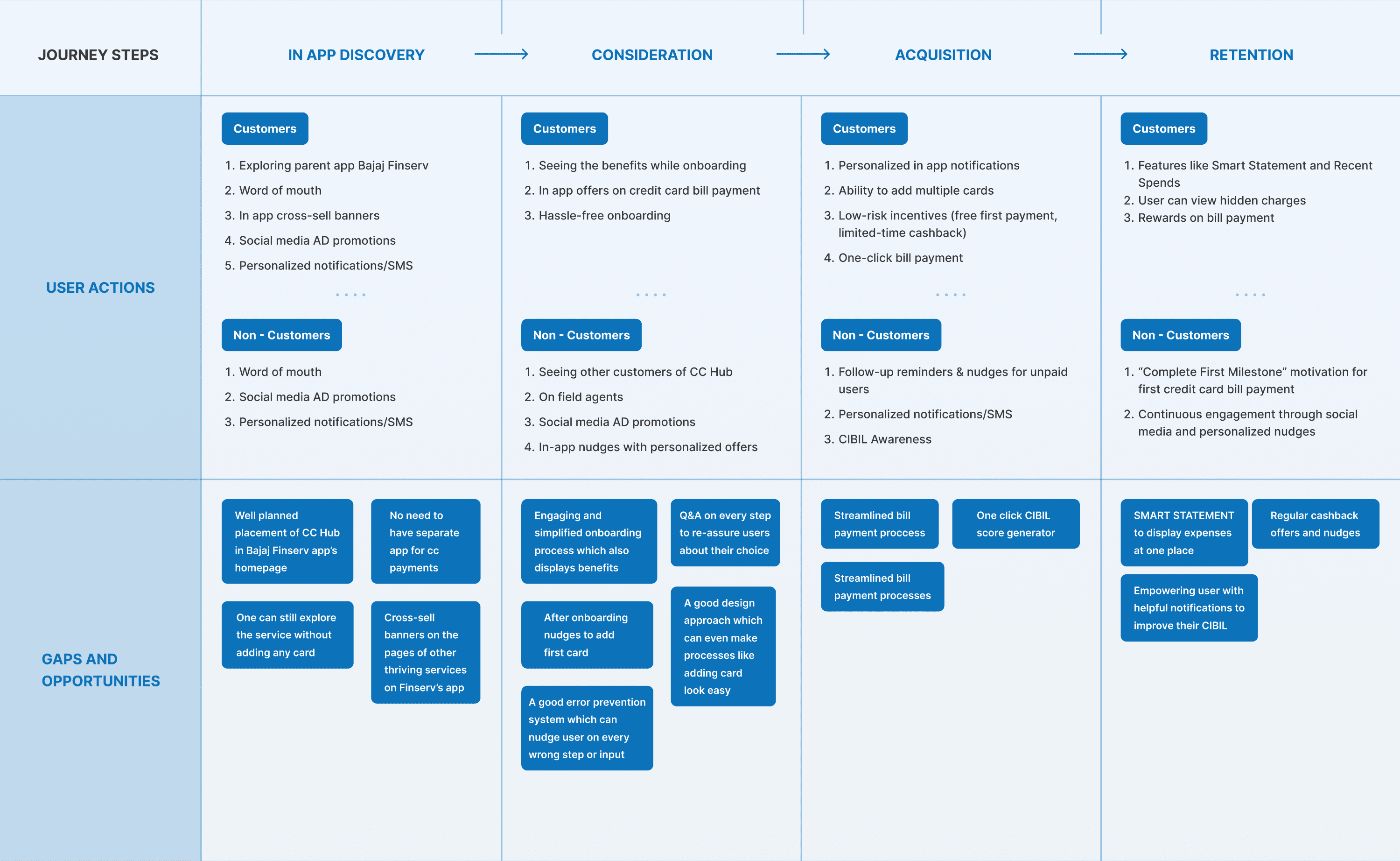
An average churn rate of 14% was being showcased in the current journey leading to high cost on user acquisition
An average churn rate of 14% was being showcased in the current journey leading to high cost on user acquisition
No engaging opportunity to showcase varied cross-business offerings is provided
No engaging opportunity to showcase varied cross-business offerings is provided
1300–1500 average daily transactions of bill payments happen on the platform, this needs to be scaled up
1300–1500 average daily transactions of bill payments happen on the platform, this needs to be scaled up
Major motivation to complete credit card bill transaction is cash-back which leads to major burn in terms of revenue
Major motivation to complete credit card bill transaction is cash-back which leads to major burn in terms of revenue
Competitor Analysis
Competitor Analysis
For competitors we considered Cred, One Card & CheQ. This process focused more around understanding different features and their following user flows.
For competitors we considered Cred, One Card & CheQ. This process focused more around understanding different features and their following user flows.
CRED

CRED
1. Smart statement can be generated for each card.
2. All spends are also shown for different cards collectively.
3. Card are tokenised with an option of multiple variants for different cards bridging a real world connect with user’s wallet and interface.
4. Multiple emails can be linked
5. Options to manage Amex cards separately as these cards have limited permissions available for TPAs.
6. Tap and pay functionality can be activated and deactivated.
1. Smart statement can be generated for each card.
2. All spends are also shown for different cards collectively.
3. Card are tokenised with an option of multiple variants for different cards bridging a real world connect with user’s wallet and interface.
4. Multiple emails can be linked
5. Options to manage Amex cards separately as these cards have limited permissions available for TPAs.
6. Tap and pay functionality can be activated and deactivated.

CheQ
1. Provides a 5 step quick onboarding
2. Cards are tokenised as per banks but doesn’t account for variants.
3. No redirection is required to check CIBIL, it can be checked upfront.
OneCard
1. Spends/Categories/Merchants can be toggled and graphical representation of each card can be viewed here.
2. Design doesn’t fashion tokenisation of cards and all information is provided in list format.

CheQ
1. Provides a 5 step quick onboarding
2. Cards are tokenised as per banks but doesn’t account for variants.
3. No redirection is required to check CIBIL, it can be checked upfront.
OneCard
1. Spends/Categories/Merchants can be toggled and graphical representation of each card can be viewed here.
2. Design doesn’t fashion tokenisation of cards and all information is provided in list format.
Understanding the Users
Understanding the Users
To gain a deeper understanding of users, we gathered data from Bajaj Finserv’s user base -
To gain a deeper understanding of users, we gathered data from Bajaj Finserv’s user base -
DEMOGRAPHIC
AGE: Bajaj Pay users mainly range from young adults (24–34) and a major chunk of middle aged users who are also merchants (34–50)
GENDER: A majority of Bajaj Pay user are male, approximately 74%
INCOME LEVEL: Middle to Lower middle income groups
LOCATION: Urban and semi urban areas (Tier 2 & 3 cities majorly)
OCCUPATION: Vendors, Merchants, retail shops, Sales executives, Property mediators, Students (College), Service employees
BEHAVIOURAL
MODERATELY TECH-SAVY: Bajaj Pay users typically utilize their phones for specific tasks, such as business payments, loan inquiries, and other financial activities
VALUE CONCIOUS: They consistently opt for policies that offer low costs and high benefits
REASSURANCE: They seek proof and validation before committing to any activity
CUSTOMER LOYALTY: They remain highly loyal to a scheme or policy as long as it benefits them and does not result in any losses.
BEHAVIOURAL
MODERATELY TECH-SAVY: Bajaj Pay users typically utilize their phones for specific tasks, such as business payments, loan inquiries, and other financial activities
VALUE CONCIOUS: They consistently opt for policies that offer low costs and high benefits
REASSURANCE: They seek proof and validation before committing to any activity
CUSTOMER LOYALTY: They remain highly loyal to a scheme or policy as long as it benefits them and does not result in any losses.
DEMOGRAPHIC
AGE: Bajaj Pay users mainly range from young adults (24–34) and a major chunk of middle aged users who are also merchants (34–50)
GENDER: A majority of Bajaj Pay user are male, approximately 74%
INCOME LEVEL: Middle to Lower middle income groups
LOCATION: Urban and semi urban areas (Tier 2 & 3 cities majorly)
OCCUPATION: Vendors, Merchants, retail shops, Sales executives, Property mediators, Students (College), Service employees
User Interviews & Insights
User Interviews & Insights
Carried out user interviews of users who hold credit cards and are active in availing credit MoM. The purpose of user interviews was to gather behavioural insights and painpoints of users.
Carried out user interviews of users who hold credit cards and are active in availing credit MoM. The purpose of user interviews was to gather behavioural insights and painpoints of users.
Sample Size: 28
Sample Size: 28
Location: Agra, Ahemedabad, Pune
Location: Agra, Ahemedabad, Pune
Age Group: 24–50
Age Group: 24–50
Type: Purposive Sampling
Type: Purposive Sampling
Insights
1. Smart statement can be generated for each card.
2. All spends are also shown for different cards collectively.
3. Card are tokenised with an option of multiple variants for different cards bridging a real world connect with user’s wallet and interface.
4. Multiple emails can be linked.
5. Options to manage Amex cards separately as these cards have limited permissions available for TPAs.
6. Tap and pay functionality can be activated and deactivated.
1. Smart statement can be generated for each card.
2. All spends are also shown for different cards collectively.
3. Card are tokenised with an option of multiple variants for different cards bridging a real world connect with user’s wallet and interface.
4. Multiple emails can be linked.
5. Options to manage Amex cards separately as these cards have limited permissions available for TPAs.
6. Tap and pay functionality can be activated and deactivated.
Insights
User Journey & Information Architecture
User Journey & IA
In an ideal scenario it only takes 5 clicks to get onboarded for CC hub, where all the cards user have are tokenised in an instant and user can start proceeding with the payments and settling their bill.
In an ideal scenario it only takes 5 clicks to get onboarded for CC hub, where all the cards user have are tokenised in an instant and user can start proceeding with the payments and settling their bill.
The Detailed user flow set a journey where various permissions required are processed as per the government guidelines meeting the legal bounds of Bajaj Finserv and RBI.
The Detailed user flow set a journey where various permissions required are processed as per the government guidelines meeting the legal bounds of Bajaj Finserv and RBI.
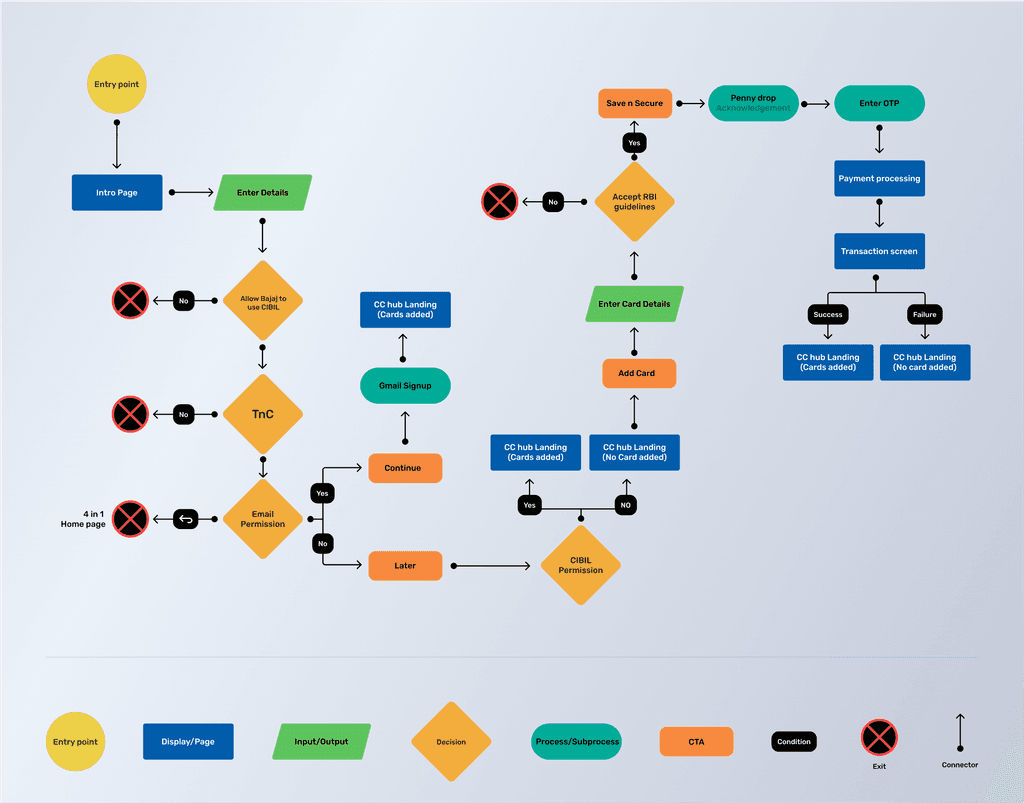
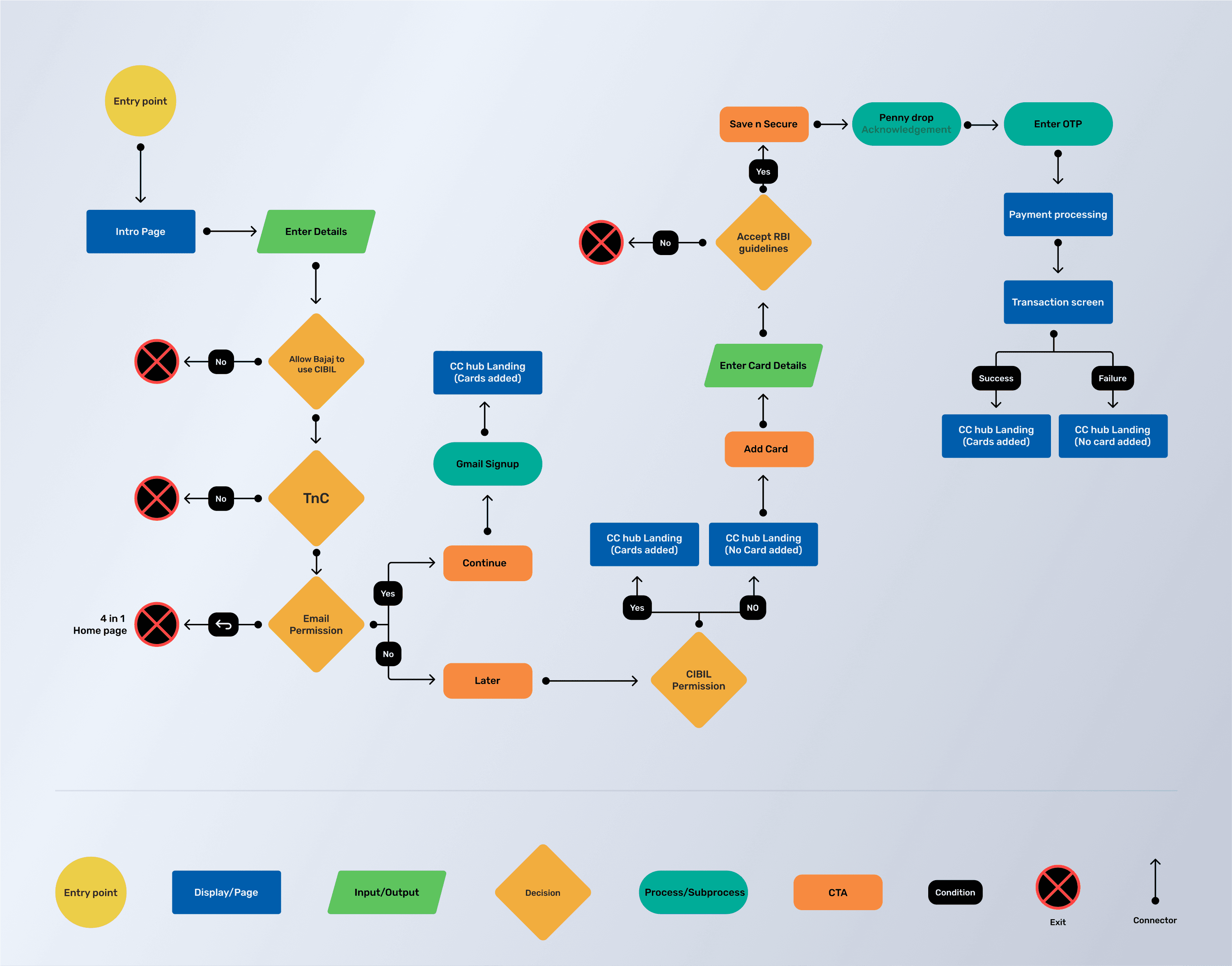
Three most important journeys of the Credit Card Hub -
Three most important journeys of the Credit Card Hub -
1. Onboarding
1. Onboarding
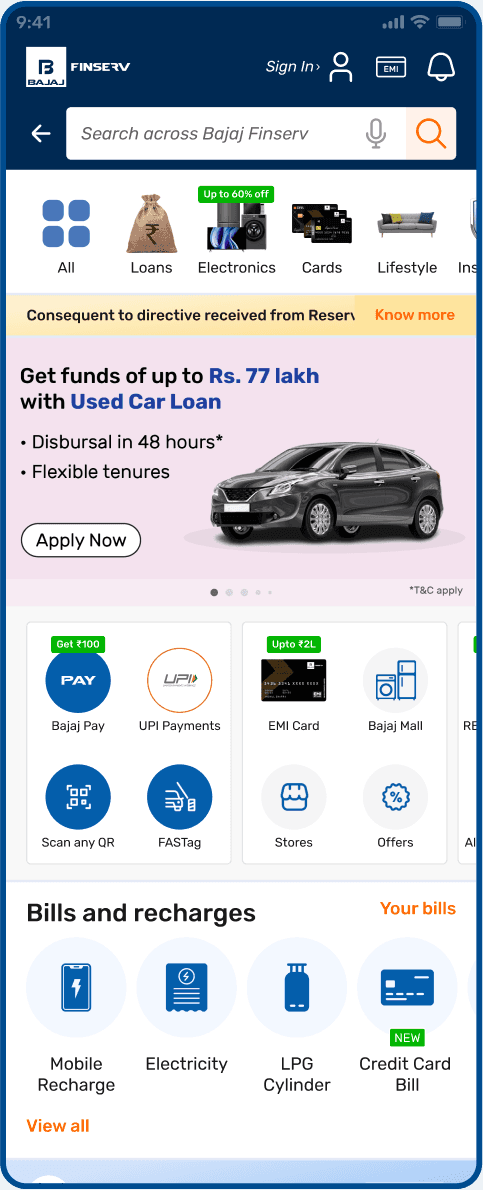
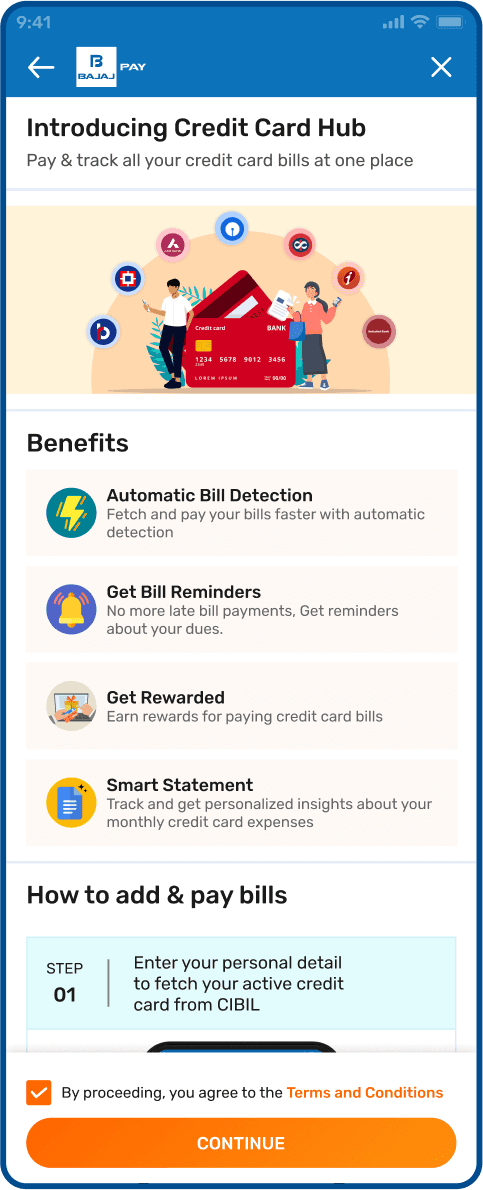
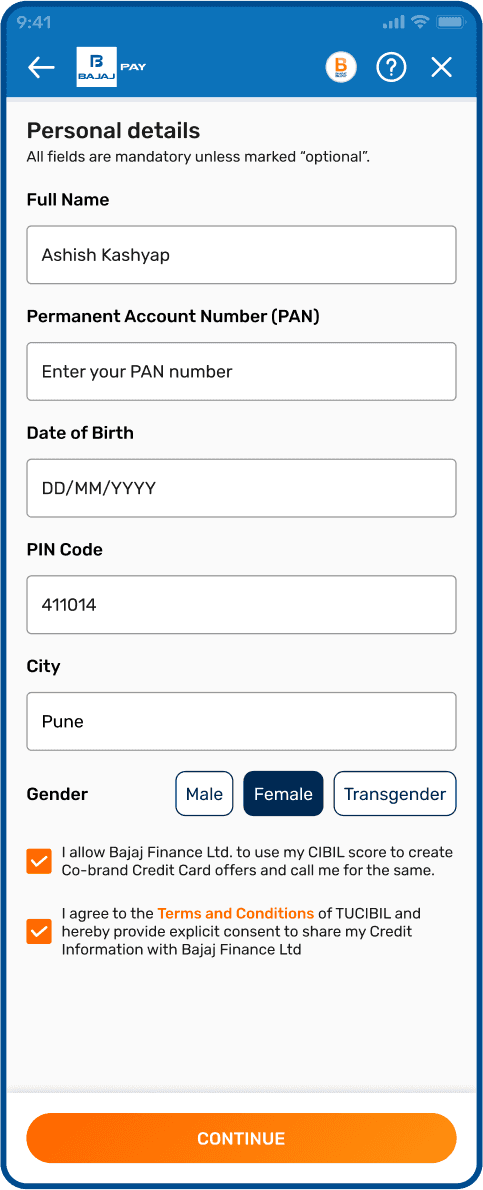
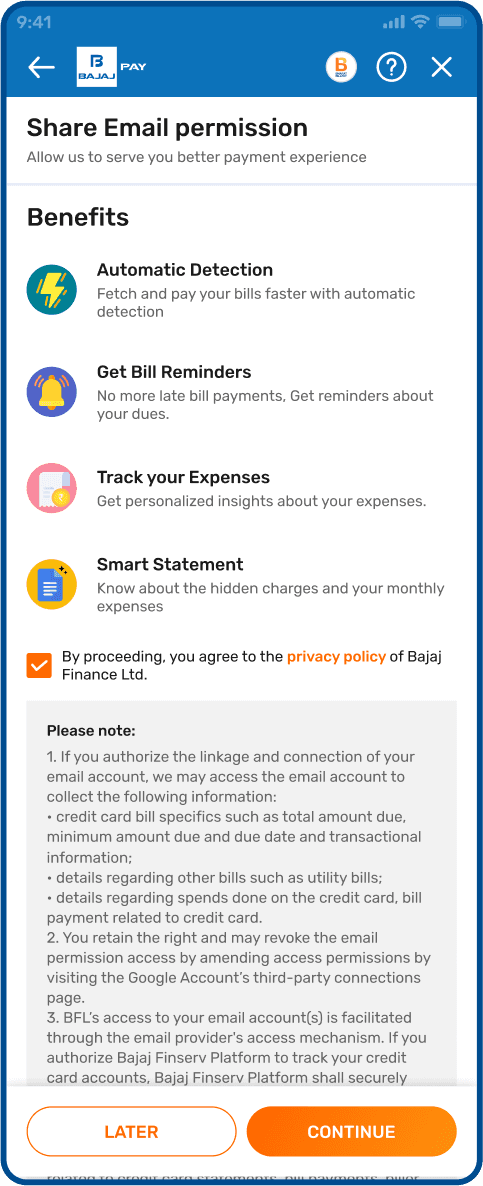
A clear and intuitive onboarding process which takes into consideration user’s consent and permissions meeting all the RBI guidelines and legal bounds of Bajaj Finserv. A lot of ambiguity was seen around users willingness to provide their email consent. Thence, an informative page is displayed in between the onboarding to keep the user informed and educated around the benefits of taking the next steps!
A clear and intuitive onboarding process which takes into consideration user’s consent and permissions meeting all the RBI guidelines and legal bounds of Bajaj Finserv. A lot of ambiguity was seen around users willingness to provide their email consent. Thence, an informative page is displayed in between the onboarding to keep the user informed and educated around the benefits of taking the next steps!
2. Settle dues
2. Settle dues
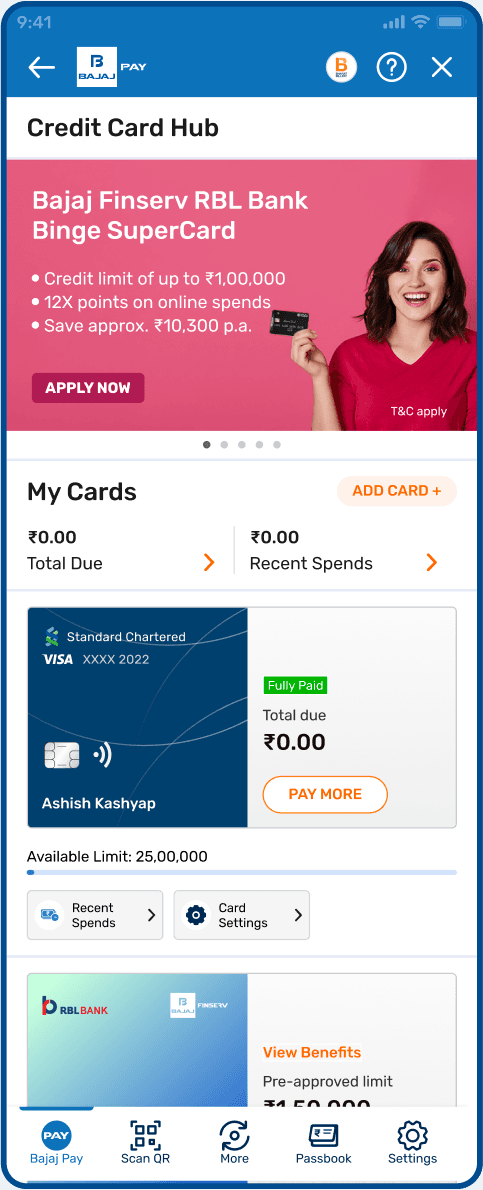
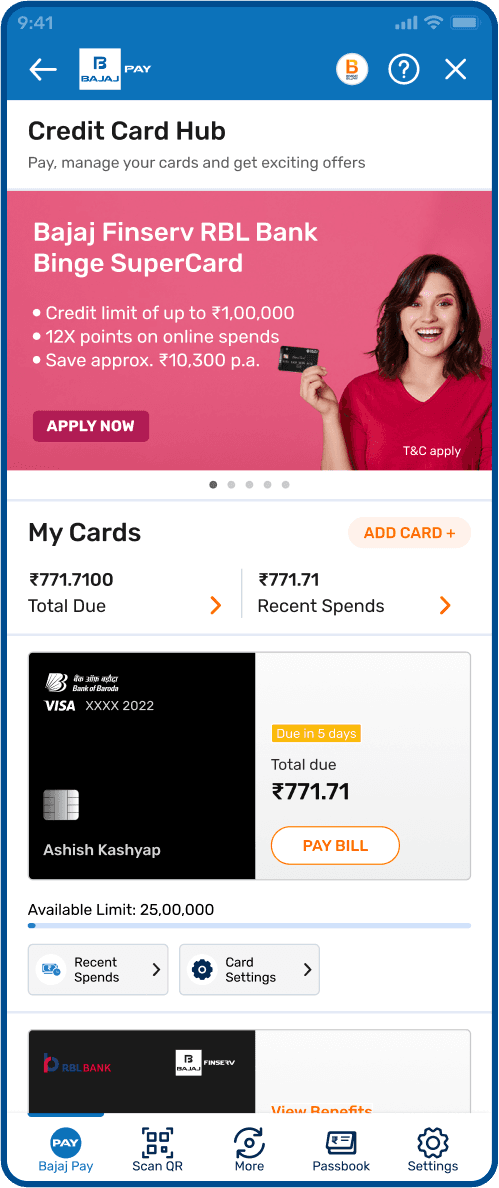
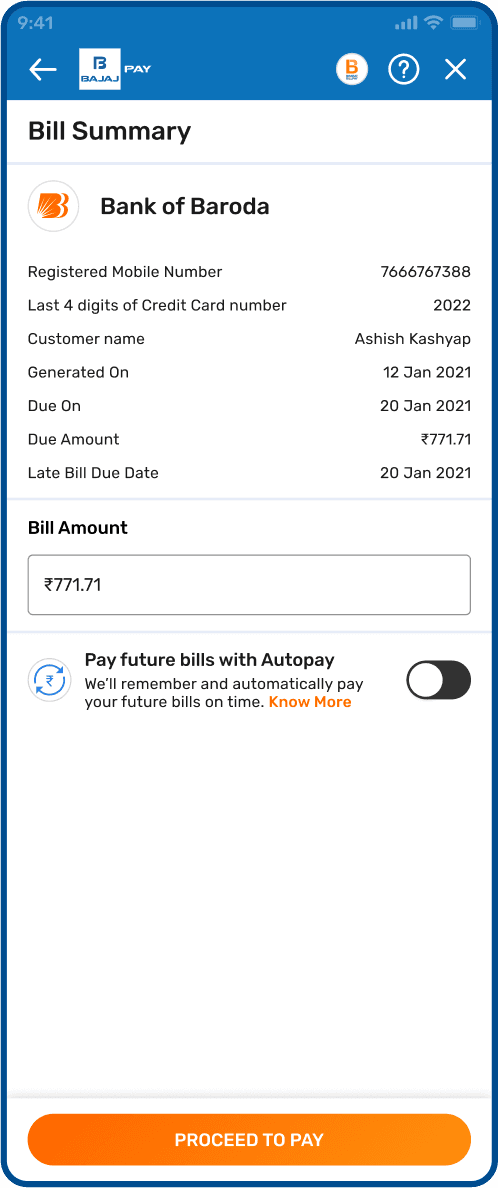
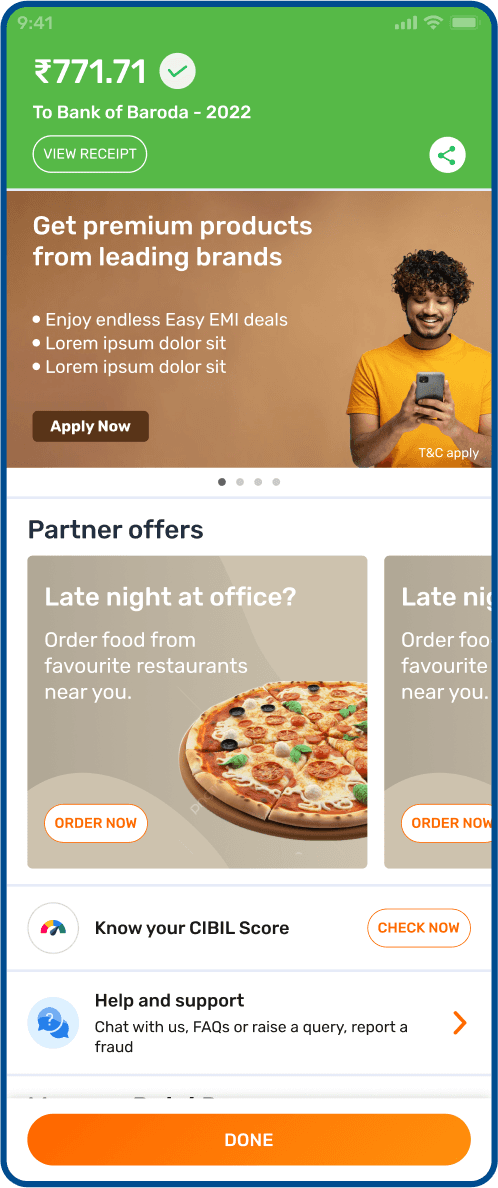
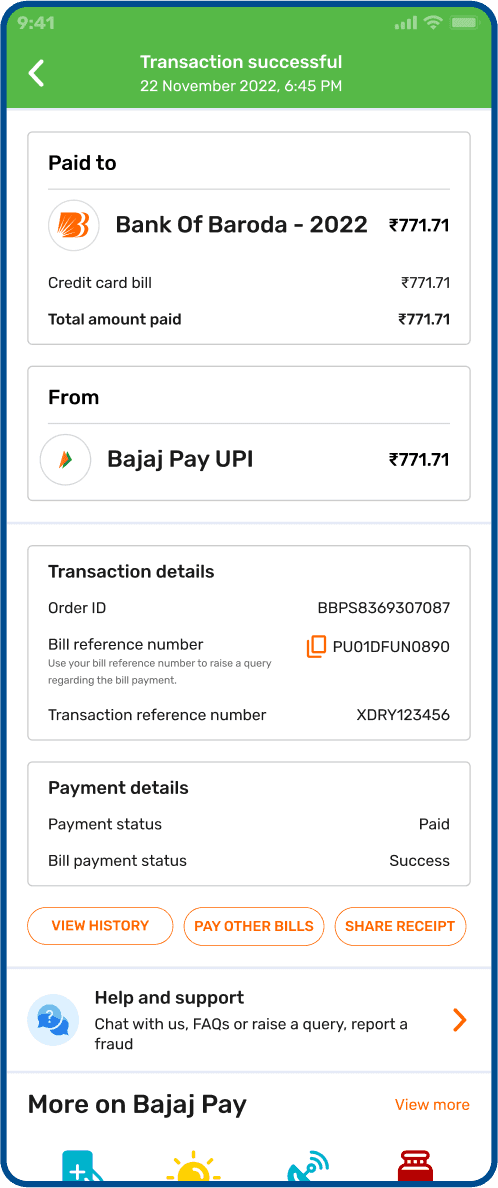
The user journey to settle upcoming or pending dues is simple and is achieved in minimal clicks. The bill amount user sees on the home page is pre filled while settling the amount to prevent error scenarios. The homepage fashions a cross sell banner at top, creating a priority for cross selling avenues and just below that user can get a comprehensive look at total due and total spends.
The user journey to settle upcoming or pending dues is simple and is achieved in minimal clicks. The bill amount user sees on the home page is pre filled while settling the amount to prevent error scenarios. The homepage fashions a cross sell banner at top, creating a priority for cross selling avenues and just below that user can get a comprehensive look at total due and total spends.

3. Manual card addition
3. Manual card addition
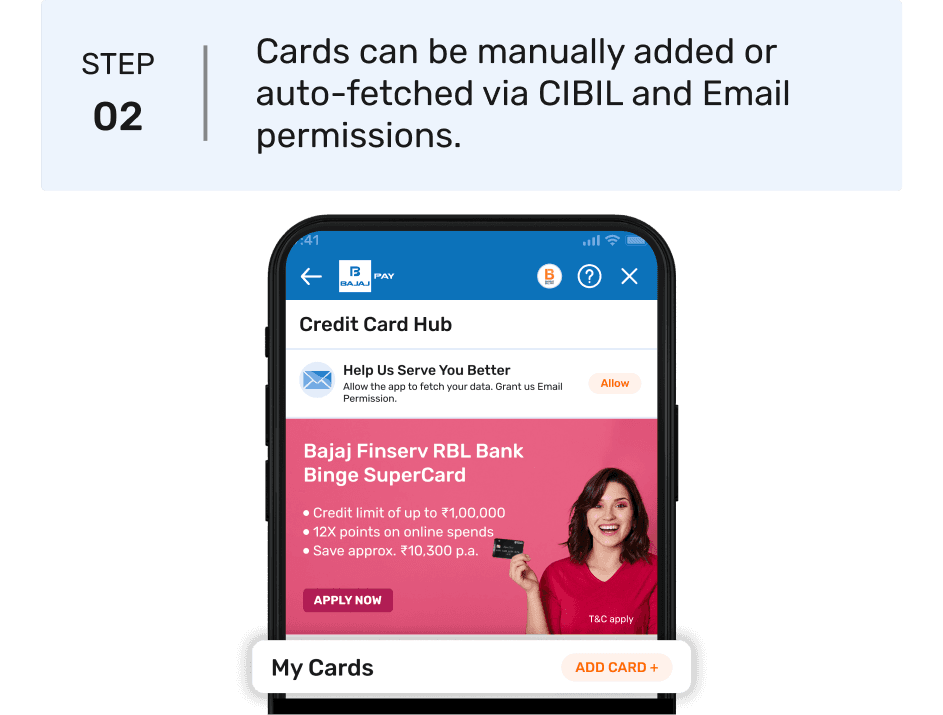
The card tokenisation process on Credit Card Hub takes into account for CIBIL and Email based permissions to gather data of user’s existing cards and ongoing and future payments and transactions they make on that card. In a case where no permission is provided by the user or skipped the onboarding, A provision to add cards manually is given.
The card tokenisation process on Credit Card Hub takes into account for CIBIL and Email based permissions to gather data of user’s existing cards and ongoing and future payments and transactions they make on that card. In a case where no permission is provided by the user or skipped the onboarding, A provision to add cards manually is given.


Results and Outcomes
Results and Outcomes
Business Metrics
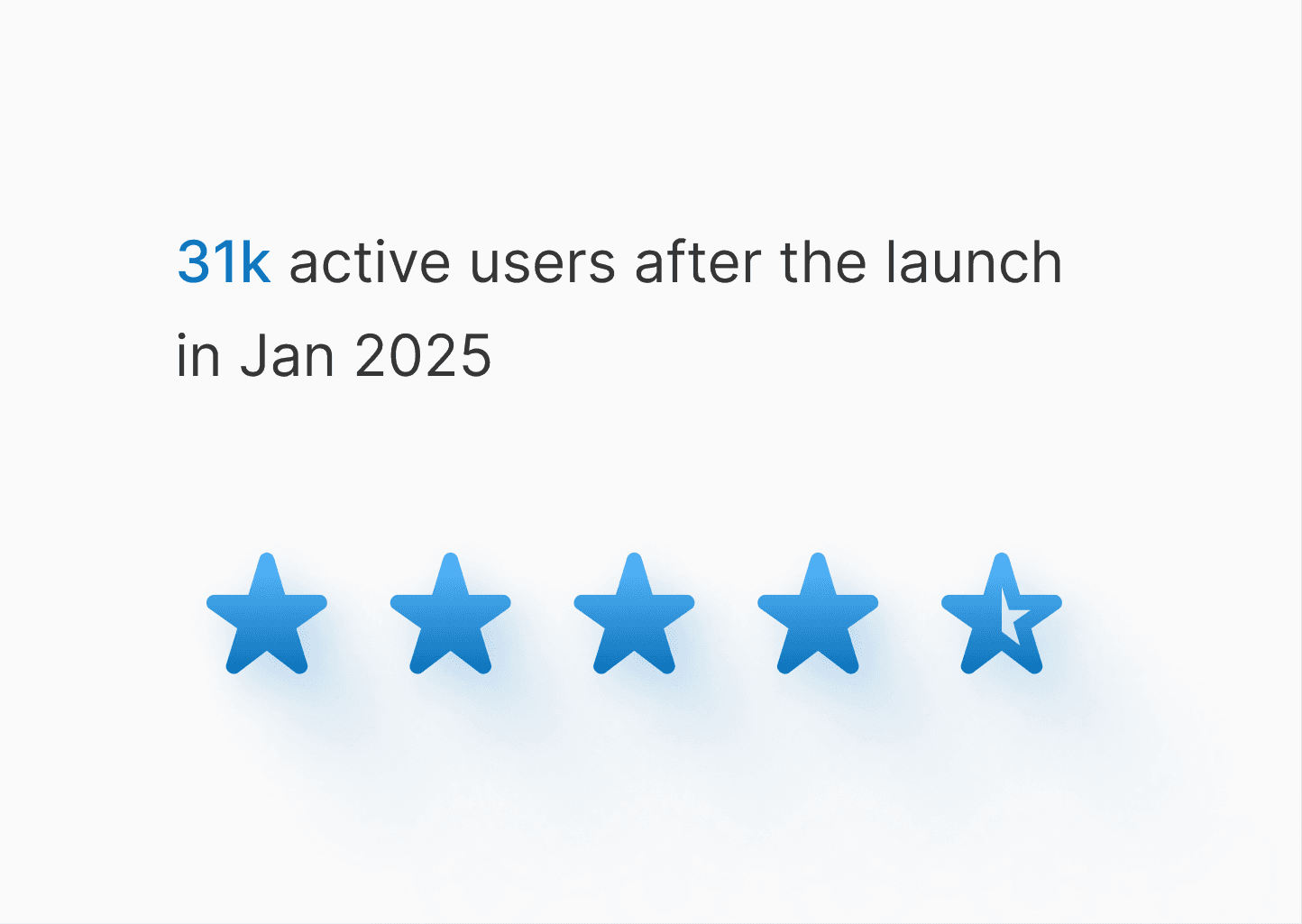
1,700+ Cards Added: Within the first 2 weeks post-launch, showcasing the streamlined onboarding process.
1.3 Lakh+ Users Engaged: The new flow attracted a significant number of users, validating the improved discoverability in a span of 3 months.
17% Average CTR: High engagement across various steps in the activation funnel highlighted the effectiveness of our task-first design.
Smart Integration: Over 1 Lakh users onboarded via email and CIBIL consent, demonstrating robust cross-channel integration.
Less Cash Burn: Since the CC Hub went live repeat & active transactions have increased with no motivation of incentives like Cash-back in place. This was not the case in Nov’23 where high cash burn was not able to improve upon user churn ratio.
Bonus: This channel paved a way for cross selling opportunity of Bajaj Finserv’s Co-branded cards, yet it was discontinued due to latest RBI guidelines.
User-Centric Outcomes
Improved Retention: The enhanced UI and usability contributed to repeated user engagement.
Reduced Friction: One-time onboarding and tokenization significantly lowered the barriers to entry.
Increased Trust: Upfront due visibility and proactive reminders fostered trust and reliability in the platform.
Creating Utility: We saw a huge traffic onboard on Credit card hub even after Bajaj Pay discontinued cash-backs. This shows features like smart statement, tokenisation, etc. have helped users in a way that retention has increased. Providing users with utility and function is the best strategy for retention.
Business Metrics
1,700+ Cards Added: Within the first 2 weeks post-launch, showcasing the streamlined onboarding process.
1.3 Lakh+ Users Engaged: The new flow attracted a significant number of users, validating the improved discoverability in a span of 3 months.
17% Average CTR: High engagement across various steps in the activation funnel highlighted the effectiveness of our task-first design.
Smart Integration: Over 1 Lakh users onboarded via email and CIBIL consent, demonstrating robust cross-channel integration.
Less Cash Burn: Since the CC Hub went live repeat & active transactions have increased with no motivation of incentives like Cash-back in place. This was not the case in Nov’23 where high cash burn was not able to improve upon user churn ratio.
Bonus: This channel paved a way for cross selling opportunity of Bajaj Finserv’s Co-branded cards, yet it was discontinued due to latest RBI guidelines.
User-Centric Outcomes
Improved Retention: The enhanced UI and usability contributed to repeated user engagement.
Reduced Friction: One-time onboarding and tokenization significantly lowered the barriers to entry.
Increased Trust: Upfront due visibility and proactive reminders fostered trust and reliability in the platform.
Creating Utility: We saw a huge traffic onboard on Credit card hub even after Bajaj Pay discontinued cash-backs. This shows features like smart statement, tokenisation, etc. have helped users in a way that retention has increased. Providing users with utility and function is the best strategy for retention.
Future Scope & Conclusion
Future Scope & Conclusion
The Future scope for this product is quite interesting as Gen-AI tech has opened new areas and totally changed how we do payments and most of all how we manage them?
The Future scope for this product is quite interesting as Gen-AI tech has opened new areas and totally changed how we do payments and most of all how we manage them?
1. Integrating AI based learnings to provide a much accurate statement as well as increase precision in categorisation of spends.
2. Introducing Rewards and Card offers in a manner that acts as a catalogue which keeps ease of discoverability as it’s foundation.
3. Integrate Bajaj Coins into Credit Card Hub.
4. Year on Year data will be provided for cards and collectively.
5. NFC based Tap n Pay functionality will be introduced in Phase 2.
6. ‘Settle in one-go’ will be provided for easy settlements.
1. Integrating AI based learnings to provide a much accurate statement as well as increase precision in categorisation of spends.
2. Introducing Rewards and Card offers in a manner that acts as a catalogue which keeps ease of discoverability as it’s foundation.
3. Integrate Bajaj Coins into Credit Card Hub.
4. Year on Year data will be provided for cards and collectively.
5. NFC based Tap n Pay functionality will be introduced in Phase 2.
6. ‘Settle in one-go’ will be provided for easy settlements.